
The alarm goes off at 5:30 in the morning. You eat whatever is fast, pack your things, and head out the door before the worst of the traffic hits. Then you wait, you queue, you ride, and somewhere between the second jeepney and the MRT platform, you do the math in your head and realize you have already spent an hour. You have not even clocked in yet.
If you are still commuting to an office every day, this is the daily structure of life, absorbed as a fixed cost of having a job without ever being fully calculated. The pesos, the hours, and the spending that pile up alongside the fare rarely get added together into a single number.
The numbers are worth putting on paper. What commuting actually costs in pesos, in hours, and in the spending you never count, adds up to more than most people have ever calculated. And what shifts when the commute is removed from the equation is worth understanding before making any career decision.
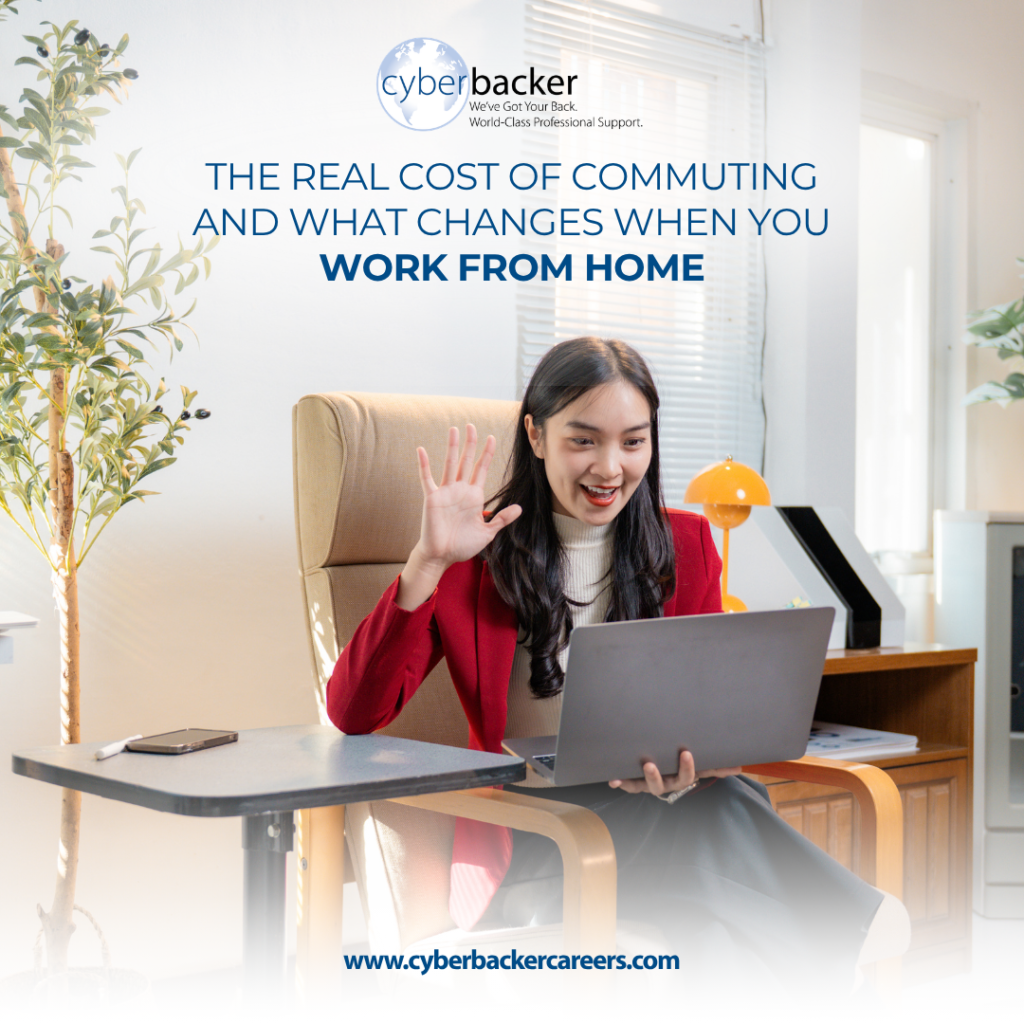
When you work in Cyberbacker, the commute disappears entirely. The setup is fully remote, and it has been since the beginning.
The Cost of Getting to Work
Most people track their commute fare the same way they track the weather: they notice it, accept it, and move on. But when you add those fares across a full working month, the total is rarely as small as it feels per trip.
Public transport fares in the Philippines have been rising steadily, shaped by fuel prices, operational costs, and the sheer weight of daily demand on an already strained system.
When you take two or more rides each way, the daily fare adds up faster than most people track it. Across 22 working days, the monthly total is rarely as low as it feels per trip, and for commuters who rely on ride-hailing services on top of fixed-route transport, it climbs higher still. Add it up across twelve months, and you will likely find you have spent more on getting to and from work than you ever stopped to calculate.
Transportation takes up 7.2% of the Filipino household budget. It shows up every month, and you have likely never added it to an annual total.
The Hours You Never Get Back
The cost of commuting is visible. The time cost is where the real damage tends to hide.
An estimated 188 hours are lost annually by workers to commuting across all transport modes. Those hours measure differently depending on how you count them, but the direction is the same regardless of the method.
Those are hours spent in traffic, not on the job, not at home, not doing anything you choose. The longer your commute, the higher the number. Two to three hours each way is a common reality, not an exception.
Working long hours on top of a long commute makes the equation even more compressed; hours lost to travel cut directly into the rest time between one workday and the next.
The Costs You Probably Stopped Noticing
Fare and fuel are the costs that show up in your mind when you think about commuting. But there is a category of spending that commuting produces indirectly, and it rarely gets counted in the same conversation.
If you have found yourself buying breakfast outside on workdays because there simply was not enough time to eat at home, that experience is more common than it should be. The same goes for buying lunch near the office because the commute home and back is too long to consider cooking. These are not poor financial decisions, but the natural result of a schedule built around a two-hour round trip before and after a full workday.
Work clothing and upkeep is another cost that disappear from the calculation. When your role requires a standard of dress, those expenses exist specifically because the job requires showing up in person. They are not dramatic individually, but when you keep up with those standards year-round, the annual cost is rarely trivial.
Then there are the incidental costs that vary by day and by route: the ride home on a night the weather turned, the convenience store stop because you missed dinner, the extra load for your stored-value card. None of these feels like commuting expenses in the moment. Over a month, they are.
The exact total varies by person, route, and lifestyle. It is likely higher than you have ever sat down to count.
What Happens to These Numbers When You Work From Home
When the commute is removed, the financial picture does not just improve in one category. It shifts across several at once.
Transportation spending drops to near zero on workdays. The daily transport cost simply stops. For private vehicle owners, so does the fuel, the toll, and the parking.
Working from home does shift some costs in the other direction: electricity and internet usage increase when you are home all day. That tradeoff is real and worth factoring in. The transportation savings will likely still outpace it, but the full picture is more useful than a partial one.
Food, clothing, and grooming costs shift in the same direction, back toward what you actually choose to spend rather than what the commute requires of you. And the hours that traffic was taking from you are returned, not as a bonus, but as time that was always yours and was never reflected in your salary.
The practical question is where a setup like that exists as the standard, not the exception. At Cyberbacker, that cost is removed entirely. There are no hybrid arrangements where you commute part of the week. The commute simply does not exist. That changes the math significantly, especially when income is dollar-denominated. When your daily transportation cost is zero, and your earnings hold against local inflation pressures in a way peso-denominated income does not, the monthly financial difference becomes concrete. That is a structural difference, not just a number.
The shift is already happening across the country: 82% of Philippine organizations are now adopting some form of hybrid or remote work. Where most organizations still ask workers to commute part of the week, the setup here removes that cost entirely, every workday, not just some of them.
When you work a full-time schedule from home with Cyberbacker, that two-hour daily commute becomes two hours of something else entirely, every single workday.
What the Numbers Cannot Capture
The value of eliminating a daily commute goes beyond what can be totaled on a spreadsheet.
When you are no longer spending two to three hours a day in transit, those hours do not simply disappear into free time. Most people redirect them toward the things the commute was quietly crowding out. That is what counterbalance looks like in practice: the weight of a full workday on one side, and enough time and energy left to actually live on the other.
Remote work also changes the relationship between where you live and what you can earn. For a Filipino worker building a remote career, geography is no longer the ceiling. The job does not require a commute. The income does not require the zip code.
At Cyberbacker, there is no adjustment period. From the first day, the commute is not part of the equation. The work was never built around proximity.
The Commute Was Never Free
The commuting cost in the Philippines has always been paid. It shows up in fares, in fuel, in meals bought outside, and in the hours that leave your day before and after the job itself. Whether you name it a cost or absorb it as a condition is the only real variable. Add the fare, add the time, add the invisible spending, and the total is worth knowing. Subtract it entirely, and the difference is worth understanding before making any career decision. When you are ready to move, apply here.