
The BPO industry has built something real. For professionals, a call center career was where discipline was forged, communication was sharpened, and the ability to perform under pressure became second nature. The skills developed on that floor are not soft skills. They are professional assets.
For many BPO workers, there comes a point in their careers when a quiet question begins to form. Not because the work was not worth doing, but because something has shifted. The skills are real. The experience is solid. And somewhere along the way, the thought surfaces: what would it look like to take all of this somewhere new?
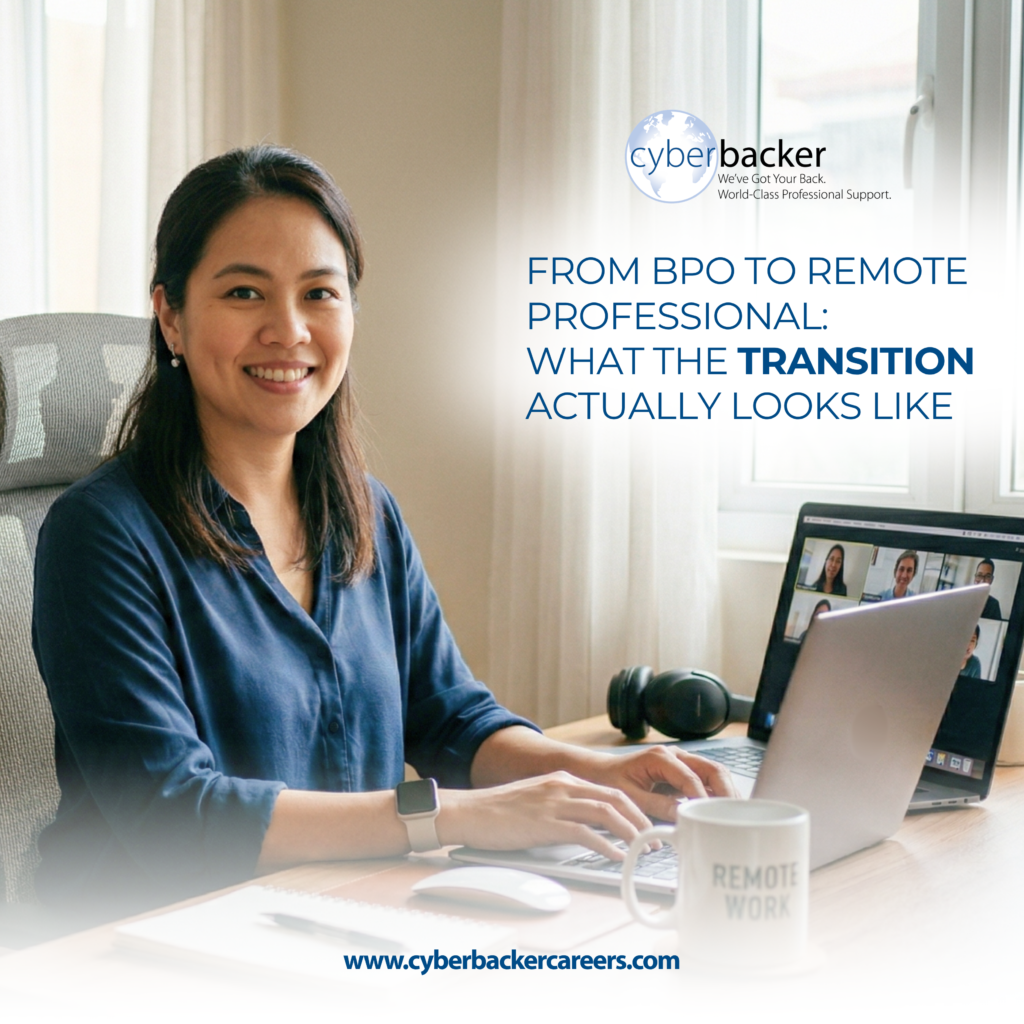
This is an honest account of what that transition from BPO to remote professional work actually looks like. What changes. What stays with you. And what life on the other side feels like once you are standing in it.
What You Are Leaving Behind and What You Are Taking With You
You are leaving the energy of a shared floor. The familiar pattern of a shift. The social texture of a team that is physically around you. These are real things, and their absence in the early weeks of remote work is something worth naming before you experience it, so you are not surprised when it lands.
But what you are taking with you is the part most people may underestimate.
The Skills That Travel Further Than You Think
Your BPO career has built a specific and genuinely valuable set of professional competencies. Not every industry can say that. Here is what travels directly into remote professional work and why it matters there.
Communication under pressure. Years of handling difficult client conversations, maintaining professionalism across time zones, and expressing complex information clearly and calmly in real time. This is one of the most valued competencies in remote professional work, and it is something you have in abundance.
Client relationship management. You already understand what it means to serve a client’s needs consistently, reliably, and across varying levels of difficulty. That understanding is the exact foundation of a long-term remote professional partnership with a client.
Task management across multiple systems. Years of navigating CRMs, ticketing systems, databases, and communication tools simultaneously, often under time pressure, have built a mental agility that remote professional work draws on directly. The platform may look different, but the skill behind it does not.
Accountability to metrics and outcomes. Performance culture in BPO is rigorous and consistent. Remote work requires the same discipline but gives the worker ownership of their own environment and the space to apply that discipline on their own terms.
Adaptability. You handle change constantly. New campaigns, new clients, new processes, new systems. That adaptability is not just a soft skill. It is one of the most practical competitive advantages you carry into a client relationship.
BPO companies in the Philippines saw productivity increase by up to 40 percent when workers transitioned to remote setups, signaling that the skills and work discipline of BPO professionals translate directly into remote performance.
In other words, the discipline you built in the call center does not disappear when you leave it. It shows up in your output, your reliability, and your ability to perform without someone standing over your shoulder.
What Is Genuinely Different and Takes Real Adjustment
The adjustment is real, and it is worth naming clearly because understanding it in advance makes it shorter.
The quiet is one of the first things people notice. After years of a buzzing call center floor, working from home can feel unusually still in the first few weeks. That stillness is not a sign that something is wrong. It is just unfamiliar, and unfamiliar takes time to become comfortable.
The discipline that drove your performance on the call center floor becomes your own to carry. It does not disappear. It just moves with you.
What the Transition Actually Feels Like
The decision to leave is often the hardest part. Not because the work was not worth doing, but because what is familiar is comfortable even when it is costing you something. Years of experience, a reputation built over time, a clear identity in a known environment, these are real things to leave behind, even when leaving is the right move.
The first few weeks of remote work after BPO often feel disorienting in ways that are difficult to predict. Tasks that should feel straightforward take longer because the environment is new. The cues that used to signal the start and end of work no longer exist. Your confidence, even with a strong track record behind you, sometimes takes a few weeks to find its footing in a new setting.
That is normal. And it passes.
“After 14 years in the call center industry, the physical and mental demands caught up with me. The turning point was when I suffered a stroke. It became clear that no amount of career success was worth sacrificing my health and time with my family. I needed a role that still honored my experience but allowed me to heal and breathe.
Starting over was terrifying. I had built a stable career, reputation, and mastery as a trainer. Moving into a virtual role felt like stepping into the unknown. But I realized that staying in a place that was making me sick was far scarier than trying something new.
Cyberbacker gave me my health and peace of mind back. My confidence returned when I realized my 14 years of experience didn’t go to waste. It became my strength. Beyond work, this career became the primary source of my wedding funds. Being able to build my future without losing myself is a full-circle moment I’ll always be grateful for.
Your health and peace are irreplaceable. Don’t wait for a crisis to realize your skills can carry you into a better life.”
— JC V., Former Call Center Agent and Trainer | cyberbacker
JC’s story is not everyone’s story. Not everyone needs a health crisis to reach this decision. But the truth his experience names is universal: the years spent in BPO are not lost when you leave. They become the foundation of what comes next.
What Changes When You Are on the Other Side
Working from home at night is a fundamentally different experience from commuting to a call center floor at night. No travel, no uniform, your own environment, your own food. The hours may be similar, but what surrounds those hours is completely different.
Filipino workers who transitioned to remote setups saved as much as 20 percent on monthly costs. For someone who spent years spending on commute, meals, and uniform, that gap is not abstract. It lands every month in a very concrete way.
The community is different, but it is real. One of the most honest fears about leaving BPO is losing the team culture. The relationships, the shared experience, the sense of belonging to something. Remote work builds community differently but deliberately. At Cyberbacker, that community is built into the structure of the career through recognition programs, team engagement, and a company culture grounded in the core value of Relationship.
How Cyberbacker Supports the Transition
The skills you bring from BPO are not just accepted at Cyberbacker. They are actively sought after because the communication discipline, the client instincts, and the performance accountability that your BPO career built are exactly what Cyberbacker’s clients need from a remote professional partner.
Before being matched with a client, every cyberbacker goes through comprehensive paid training that bridges the gap between call center work and remote professional standards. This covers professional communication systems, client management tools, and the specific expectations of each role, so that when a cyberbacker begins working with a client, they are already prepared to perform well from day one.
The matching process itself considers your professional background, the roles you selected, and what you expressed during the values assessment and interview. Your background carries real weight here. The years of experience are not treated as a liability to overcome. They are treated as exactly what they are, a foundation worth building on.
The company’s President, Shiela, started her career at 18 in a call center too. She advanced through technical support and sales roles, stepped away from the workforce to focus on family, and came back through Cyberbacker, eventually becoming its President. Her story is the clearest possible proof that the BPO-to-remote transition is not just possible. It is the beginning of something that can grow much further than most people allow themselves to imagine.
Your Experience Does Not Disappear When You Leave
The years you spent in BPO did not prepare you for nothing. They prepared you for this. The communication you built. The client instincts you developed. The discipline you practiced shift after shift, year after year. All of it travels.
The transition is real, and it has an adjustment period. But on the other side of that adjustment is a career that works with your life, values what you have built, and gives it somewhere new to grow.
If the question has already started forming, that is worth paying attention to. Apply Today!